Electronic Blood Sensor Detects Early Parkinson’s Markers With 90.9% Accuracy in Early Trial
Researchers at KAUST and Oxford developed an electronic blood sensor that detects three forms of alpha-synuclein linked to Parkinson's disease, achieving 90.9% accuracy in a blinded test of 59 people, though larger prospective trials are still needed.
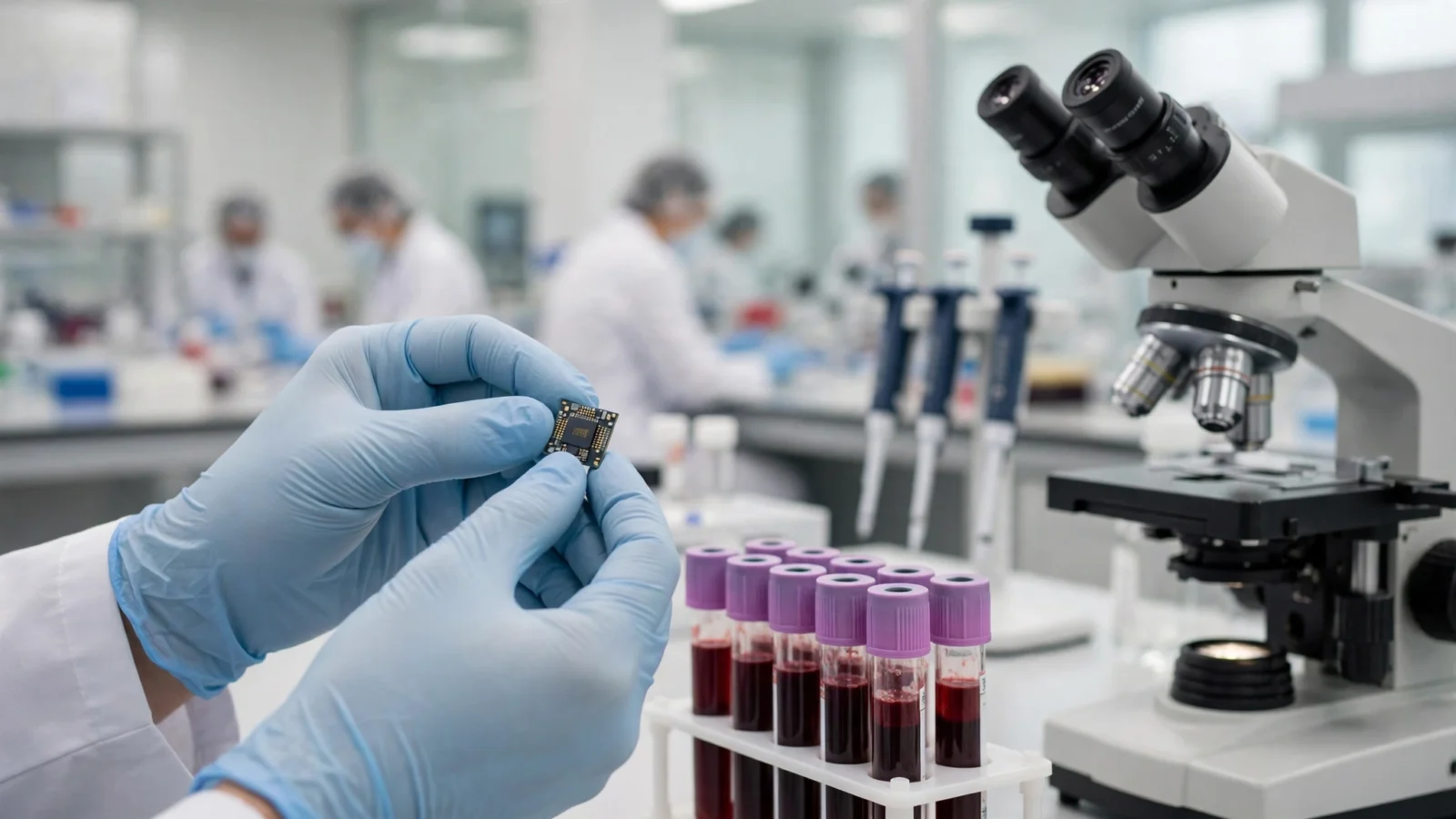
Researchers at King Abdullah University of Science and Technology (KAUST), working with colleagues at the University of Oxford, have developed an electronic blood sensor that can detect molecular signatures linked to Parkinson’s disease, according to a report published in Science Advances and summarized by News-Medical.
The system uses an organic electrochemical transistor to measure three forms of alpha-synuclein at once. Alpha-synuclein is a protein closely associated with Parkinson’s, but measuring the brain-related signal in blood is difficult because more than 95% of the alpha-synuclein circulating in blood comes from red blood cells, creating heavy background noise, according to News-Medical. To get around that problem, the team first isolates tiny packages released by nerve cells into the bloodstream, then analyzes their protein contents. The transistor amplifies very small biological signals into larger electronic signals, allowing all three forms to be measured within 40 minutes.
Early results, with larger trials still ahead
In a blinded evaluation of 66 participants from the Oxford Discovery cohort, including people diagnosed with Parkinson’s, healthy controls, and people with isolated REM sleep behavior disorder, the platform distinguished disease-associated profiles from healthy controls with 90.9% accuracy, according to News-Medical. The researchers found distinct patterns across the three forms of alpha-synuclein, suggesting that measuring them together may offer more diagnostic information than any single marker alone.
Sahika Inal, an associate professor of bioengineering at KAUST, said changes linked to Parkinson’s can begin long before a clinical diagnosis, and that the approach can detect several forms of alpha-synuclein together at extremely low concentrations, according to News-Medical. She described the early results as encouraging and said the next step is validation in much larger groups of patients. The team cautions that the technology is not yet a standalone clinical blood test and that larger, prospective, multicenter studies are needed before it could be used routinely in healthcare.
Reporting based on coverage by News-Medical.